Get Certified for
Capital Markets (CMSA®)
From equities and fixed income to derivatives, the CMSA certification bridges the gap from where you are now to where you want to be — a world-class capital markets analyst.
A collection of stocks that are used to assess the performance of an economy, market, or specific sector
A stock index, also called a share index or stock market index, consists of constituent stocks used to provide an indication of an economy, market, or sector. A stock index is commonly used by investors as a benchmark to gauge the performance of their portfolio.
Examples of stock indexes include the Dow Jones Industrial Average (DJIA), the Nikkei Stock Average, the S&P 500, the Nasdaq Composite, and the Wilshire 5000.
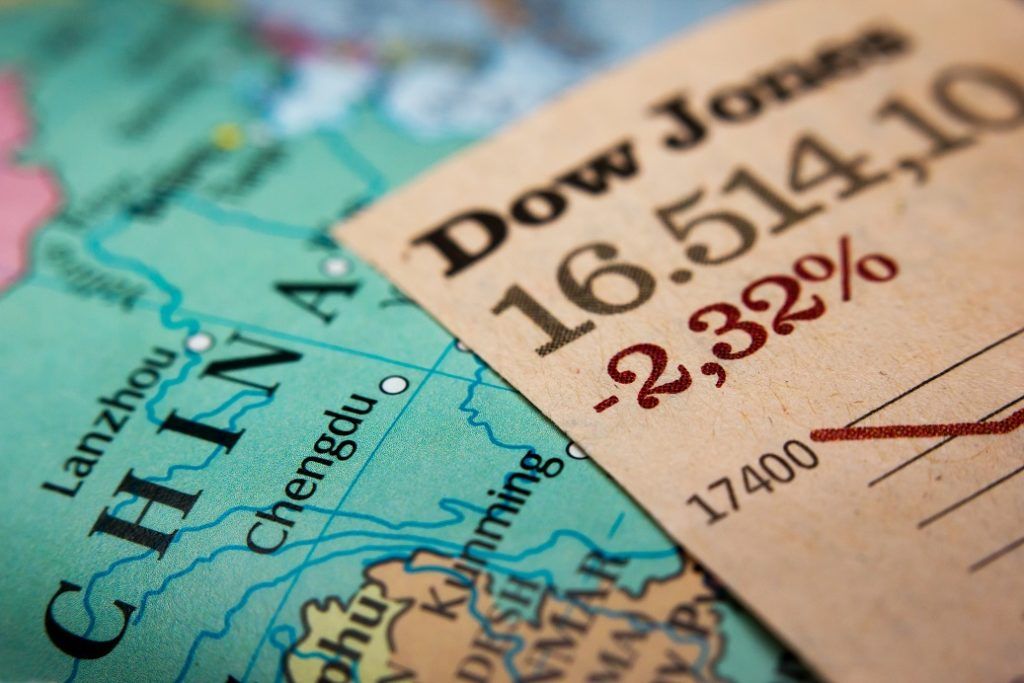
A stock index is comprised of constituent stocks that, when pooled together, provides an indication of something. For example:
The Dow Jones Industrial Average and S&P 500 are used in mass media to provide a broad indication of economic performance in the United States.
Stock indexes can follow different weighting methods, such as a:
For example:
The weighting method used carries implications on the performance of an index.
The S&P 500 chart is taken from Google and provided below:
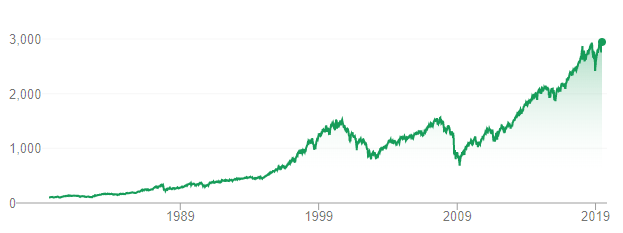
Recall that the S&P 500 is used in mass media to provide a broad indication of economic performance in the United States. From the S&P 500, we can discern economic events in each major downtrend of the index, including:
As one can see, the S&P 500, comprising the top 500 U.S. stocks by market capitalization, provides a fairly accurate representation of major economic events.
Colin recently decided to create two stock indexes.
The first stock index, provided below, consists of five automobile stocks that he believes provide a good representation of the automobile industry in the United States:
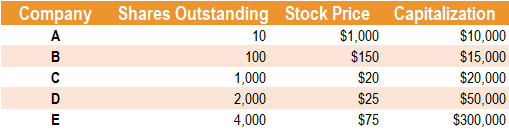
Using a capitalization-weighted index, the value of the stock index above is $10,000 + $15,000 + $20,000 + $50,000 + $300,000 = $395,000.
The second one, provided below, consists of five telecom stocks that he believes provide a good representation of the telecommunications industry in the United States:

Using a capitalization-weighted index, the value of the stock index above is $50,000 + $1,500 + $7,000 + $46,250 + $243,750 = $348,500.
The next day, the US president imposes a 50% tariff on steel imports. The market index constructed by Colin is now as follows:

Using a capitalization-weighted index, the index’s value is $9,000 + $13,500 + $18,000 + $45,000 + $270,000 = $355,500, which is a decrease from $395,000 before the implementation of the steel tariffs. Colin is able to see that the steel import tariff imposed by the US leader negatively affected the automobile industry.

Using a capitalization-weighted index, the index’s value is $50,000 + $1,500 + $7,000 + $46,250 + $243,750 = $348,500, which is identical to the value before the implementation of the steel tariffs. Colin is able to see that the steel import tariff imposed by the US leader did not affect the telecommunications industry.
CFI offers the Capital Markets & Securities Analyst (CMSA®) certification program for those looking to take their careers to the next level. To keep learning and advancing your career, the following resources will be helpful: